Tuesday, July 30, 2013

Tactics, tactics, tactics...

The best advice you will ever get in order to improve your chess from a beginners level, as mine is still, is tactics, tactics, tactics... You may have heard people tell tou to solve about a 100 problems a day, I would rather tell you, do as much as you can within a set timeframe, 10 minutes, half an hour, an hour... whatever suits your schedule.

Once you face a problem, unless is straightforward, keep cool, take your time, try to solve it on your own, perhaps writing down on a piece of paper the possible moves you think and the possible responses. Then check the solution, see if yours was correct and continue to the following... The key idea of this kind of problems is to develop pattern recognition, and believe me, it works!

Once you get stronger with tactics combinations you will do better at the oppening, without yet learning all the infinite variations, and you will start to have more chances of nice victories.

I played this game today, usually I hate to face weird openings as the Scotch defense, nevertheless, although I'm unfamiliar with this game I try to follow the basic principles:


1. e4 d5 {The sccoth game}
2. exd5 De5+ {I take the gambit, then the queen checks me}
3. Cc3 {Develop the knight, threting black queen, hence wining a tempo}
3... De5+ {Again check}
4. Ae2 {Develop the bishop}
4... b6 ?! {Preparing a fianchetto. This is a mistake because}
5. d4 Dd6
6. Cf3 Ab7
7. Cb5 Dd8
8.Af4 a6??
9. Cxc7+ Rd7
10. Ce5+! Black resigns, as it will lose his queen and rook!

[The following continuation is sugested by the computer: 10... Rxc7 11.Cxf7+ Dd6 12. Axd+ exd+ 13.Cxh8 Axg2 14.Tg1]

Saturday, July 27, 2013

Importance of training endgames

Arriving to the endgame stage against a stronger player is by itself an accomplishment, where you can, if you play accurately, win or at least force a draw. It is, therefore, very important to gain the knowledge of endings, so as not to fall down due to bad technic after all the efforts of getting there.

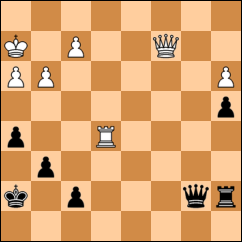
This happened to me today at this game, where at the end, I overlooked his trap at move 61, losing the h5 pawn, thereby the game. After reviewing the game it is clear that the correct move should have been 61... Qf3 protecting the pawn, attacking also a3.


The game:
 

Thursday, July 25, 2013

Chess Tip: Always play against stronger opponents

This tip can be somewhat quite frustrating as you will have fewer oportunities to win, hence mining your ego. The key is to look at your inevitable subsequents defeats as a valuable learning resource. Then, once in a while you will have a nice and tasty win that will recover your rating and most importantly your ego points.

I'm sharing with you one of this tasty wins, it was this morning at a 15min game at chesscube.com playing blacks against a player +117 elo stronger. Of course, this game might be full of blunders, but nevertheless I feel great.

Wednesday, July 24, 2013

Thomas Bowdler - Henry Conway, London 1788


Just testing how the interactive chess viewer of gameknot looks like within blogger.

King struggle


The white king is struggling, nevertheless it has some defence options, at least for a few more moves. Black to move, what would be the best move possible?

First obvious move might be Rxc5+, but after Kd4 you will end up with a simple piece exchange, I feel that something better is achivable...

At second glance, I thought in setting a trap with Nb2, hoping that after Kxb2 would follow a mate in 2, but whites has a clever answer for this, forking both rooks with Nd7 (Tip: Never underestimate your opponent)

Finally, after careful thinking (in fact it was after naively setting the trap and get a rook fork in return), the answer shows up... Can you see it?

My first post

I started this blog as a dual challenge, first to record this faboulous journey of learning Chess and last but not least, writing it in a foreing language for me, English.